

Challenges of Intelligent Urban Rail Transit
Data silo
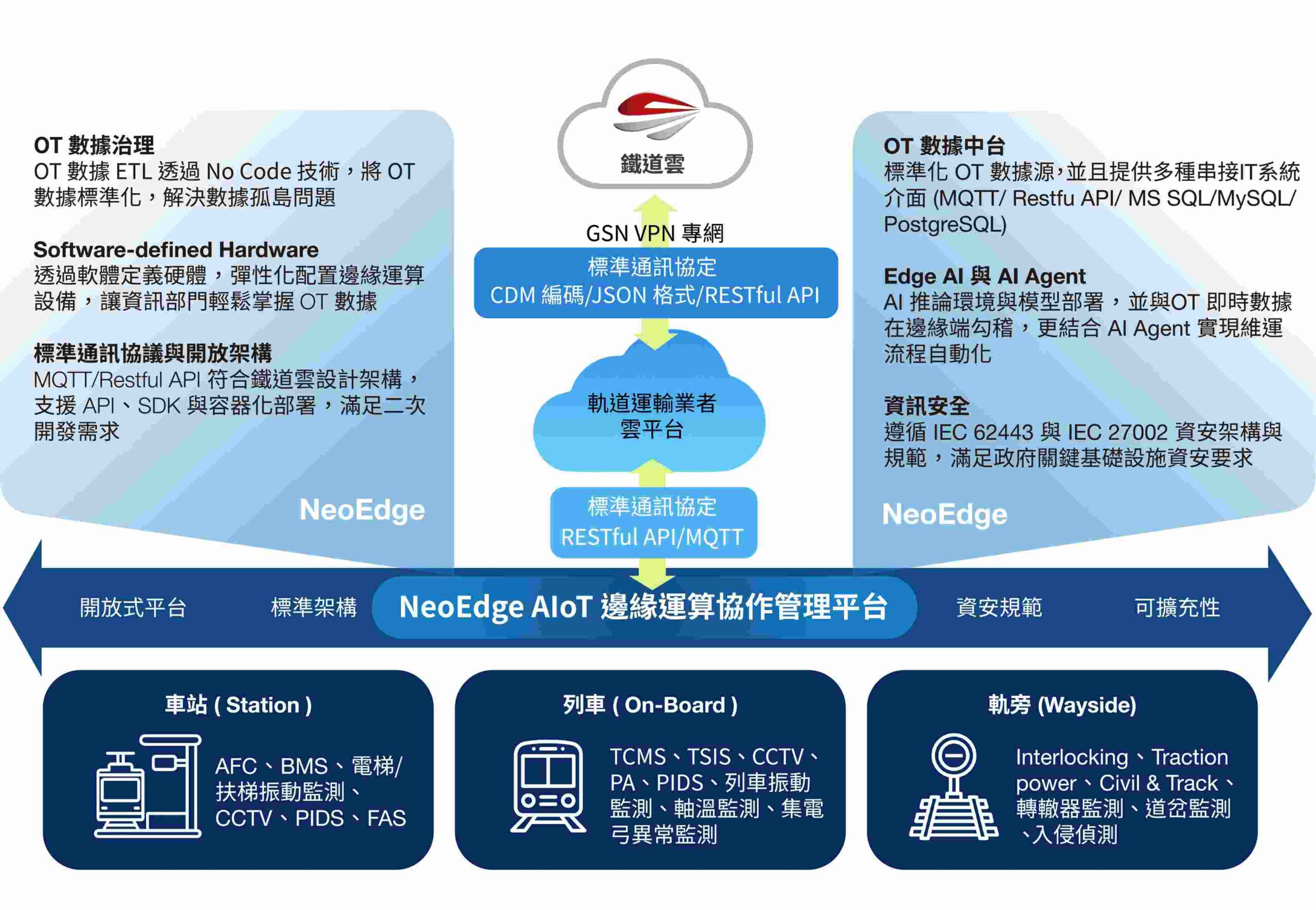
The OT system involves areas such as stations, trains, and trackside. Different units are responsible for various systems, and the lack of standardized interfaces makes OT data collection difficult, hindering its integration with IT systems.
The gap between OT and IT in terms of knowledge and capabilities
OT personnel lack knowledge and capabilities in IT and cybersecurity, while IT personnel are unfamiliar with OT field equipment, leading to a communication gap between them.
High safety and reliability requirements
Orbital transportation is considered critical infrastructure, and the introduction of new technologies must comply with cybersecurity regulations and reliability standards to ensure the safety and uninterrupted operation of the entire transportation system.
Domain knowledge combined with AI
Possessing industry knowledge but lacking AI technology knowledge, leading to roadblocks in implementing AI technology and hindering the smooth promotion of AI applications.
Energy efficiency needs improvement
How station air conditioning electricity consumption and train traction power can support green transportation and reduce carbon emissions is also an important topic.
Labor costs and professional gaps
The field inspection workforce is gradually becoming insufficient, with a lack of professional technical personnel. How can AI and digital tools be used to support this?
Do you have the following needs?
Decision maker
CEO/Chief Information Officer/Chief Digital Transformation Officer
- •Enhance IT's visibility and control over OT domain data, thereby breaking down data silos.
- •Establish a standardized OT data management platform and process to reduce the challenges of implementing OT systems.
- •Adopt an open architecture (SDK/API/containerization) to ensure IT has future scalability
- •Ensure compliance of IT/OT cybersecurity architecture
IT personnel
Information Department / Digital Transformation Team / R&D Unit
- •Edge side processing of heterogeneous OT data and connection to IT systems
- •Remote bulk deployment and tuning via the platform to reduce on-site support requirements
- •Support for hybrid cloud architecture to balance data and security
- •AI-Powered Digital Transformation
Occupational Therapist
Facility Management Engineer / Vehicle Maintenance Engineer / Power Engineer / Track Engineer
- •Collect data and automate without writing code
- •Scalability to meet the data collection needs of different types of devices
- •Equipment anomaly prediction diagnostics reduce unexpected downtime
- •Write data back to the database or cloud platform according to IT requirements.
- •Implement AI tools and combine them with your industry knowledge to optimize workflows and improve efficiency.
Case Studies

Station
Station energy consumption is enormous, and peak electricity demand creates operational cost pressure.
Existing air conditioning and elevator systems are mostly on fixed schedules or manually adjusted, lacking real-time intelligent control.
• Maintenance mode mainly relies on scheduled inspections, making it difficult to predict anomalies early and leading to unexpected failures.
Read more
Train
Infrastructure such as tracks and turnouts are susceptible to wear and tear, settlement, and climate disasters, requiring extensive manual inspection.
The manual inspection of minor abnormalities in fasteners, switch points, etc., is inefficient and makes it difficult to detect potential risks early on.
If abnormal sparks from the pantograph and geometrical deviation of the catenary are not detected in real-time, it could lead to service disruptions.
Data from different sensing equipment (vibration, acoustic, imaging, torque, current, etc.) is scattered and lacks integration.
Read more
Trackside
Train operations face pressure concerning energy efficiency and carbon emissions.
• Passenger experience demands are increasing (comfort, safety, information transparency), but existing systems are mostly passive responders.
• Vehicle equipment is complex, making it difficult to keep track of multi-point failures in doors, air pressure, batteries, etc. in a timely manner, resulting in high downtime costs.
Wheel noise detection.
Read more